Subscribe

Table of Contents
- 1 Project Background
- 2 Challenge: How Rooms Really Behave
- 3 Solution Overview: Sol-In ECO-IN AI Strategy
- 4 Pilot Design & Methodology
- 5 Findings – Occupancy & Usage Patterns
- 6 Findings – Indoor Air Quality: CO₂ and Particulate Matter
- 7 Findings – Thermal Comfort & FCU Runtime
- 8 Mode Comparison: CAV vs Sol-In AI (DCV)
- 9 Energy & Cost Savings – Per Room
- 10 Energy & Cost Savings – Scaling to the Whole Hotel
- 11 Compliance, MRV & ESG Impact
- 12 Recommendations & Next Steps
- 13 About Sol-In & ECO-IN
This case study explores a three-day pilot of the Sol-In AI HVAC and IAQ management platform in a typical urban hotel. The test was conducted in a standard 20 m² double room with a balcony facing the street, equipped with a fan coil unit (FCU) but no key-card control. The goal was simple but ambitious: to understand whether a hotel can significantly reduce HVAC energy use without compromising guest comfort or indoor air quality (IAQ).
Using one Sol-In IAQ sensor and one controller connected to the room’s FCU, the system continuously monitored the room over 72 hours. During this time, Sol-In collected real-time data on occupancy patterns, CO₂ levels, particulate matter (PM2.5), temperature and thermal comfort. This provided a detailed picture of how the room is actually used versus how the HVAC system operates today.
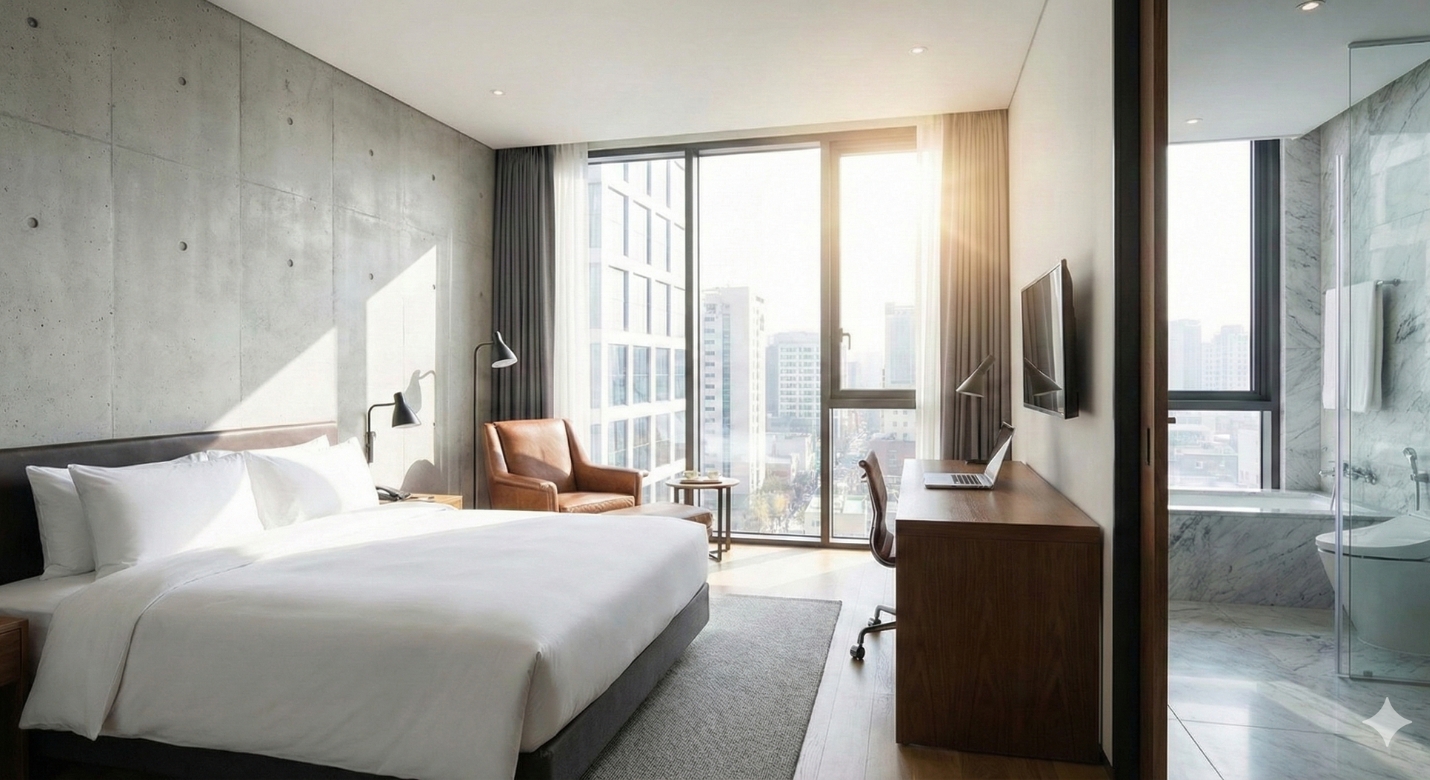
The data revealed a clear mismatch between guest behavior and HVAC operation. The FCU provided cooling but no fresh air; effective ventilation occurred only when the balcony door was opened. While the room was occupied just 44-56% of the monitored time, the FCU ran 100% of the time, locked at 22°C. In practice, this meant roughly 40 hours of unnecessary cooling over the 72-hour period. CO₂ levels rose quickly when two guests were present in the 20 m² room but remained within mid-range values, while PM2.5 spikes consistently appeared whenever the balcony door was opened to the street, bringing outdoor pollution into the space.
Sol-In AI was then used to model an alternative operating strategy based on Demand-Controlled Ventilation (DCV). Instead of constant operation (CAV), the system adjusted runtime and setpoints according to real occupancy and IAQ needs. The result was a runtime reduction of approximately 45-56% for the FCU, while still maintaining target CO₂ levels and guest comfort (including slightly higher, more natural temperatures at night).
Financially, the impact is substantial. Under the modeled DCV strategy, the annual HVAC energy cost for a single hotel room drops from approximately $980 to $270, yielding an estimated saving of $710 per room per year. Scaled to a 100-room hotel, this translates to around $71,000 in annual savings, even before accounting for seasonal variations and reduced cooling days. Alongside energy and cost reductions, the system also supports better IAQ control, more precise thermal comfort management, and provides the measured, reportable data needed for compliance with LEED, WELL, ASHRAE, RESET and local standards.
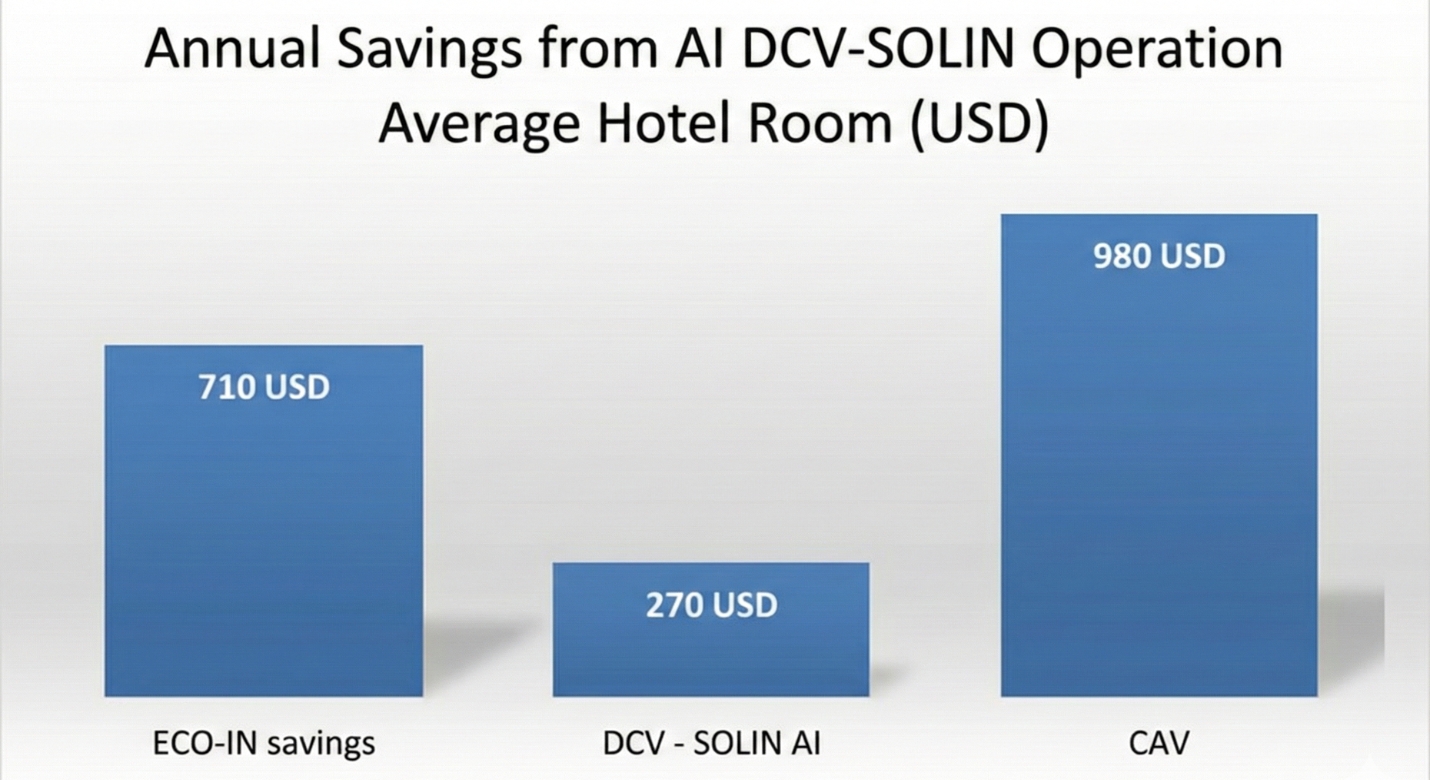
Figure 1: Annual HVAC energy cost per hotel room – constant 24/7 operation (CAV) versus AI-driven demand-controlled ventilation (DCV) with Sol-In.
Project Background
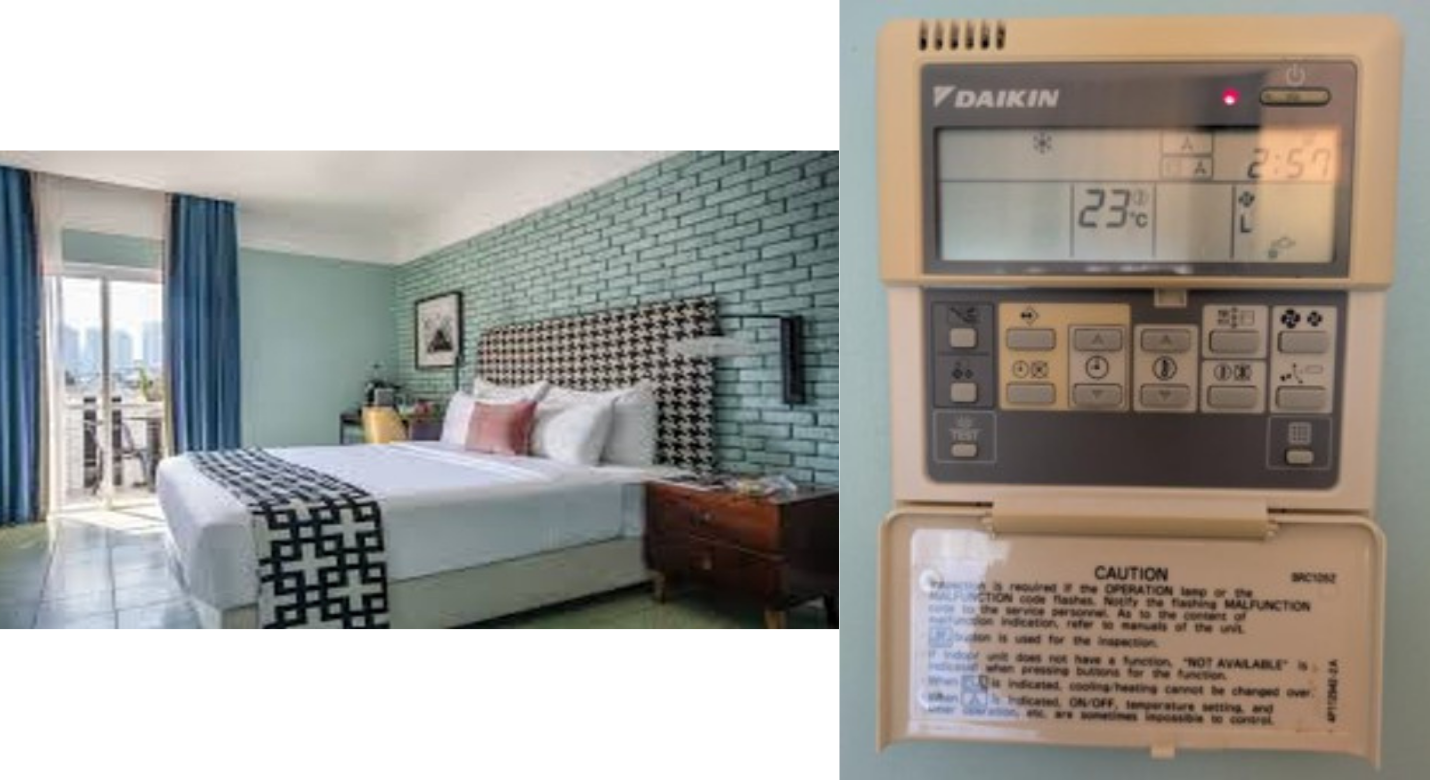
The pilot was carried out in an urban business hotel – the kind of city property that hosts a constant mix of business travelers, tourists and conference guests. We focused on a standard double room of approximately 20 m², designed for two guests and featuring a balcony facing a busy street. Like many hotel rooms worldwide, it relies on a fan coil unit (FCU) for cooling and heating, with no dedicated fresh-air supply into the room itself.
In the existing setup, the FCU operates independently of room occupancy and continues running as long as it is switched on, even when the room is empty. The FCU is managed by a locked Daikin controller: guests can only turn the system on or off, but cannot adjust core operating parameters such as minimum/maximum temperature, modes or schedules. As a result, the default behavior is continuous operation at a fixed setpoint, typically 22°C, whether the room is occupied or empty.
From the hotel’s perspective, this created both cost and experience challenges. Energy prices have been rising, and management is under pressure to reduce operating expenses without hurting guest satisfaction. At the same time, there is a growing awareness of indoor air quality (IAQ) and its impact on guest comfort, complaints and online reviews. The hotel is also increasingly engaged with ESG reporting and green building practices, looking ahead to alignment with frameworks such as LEED and WELL, and to the ability to demonstrate measurable improvements rather than relying only on “good intentions.”
Partnering with Sol-In for this pilot allowed the hotel to explore a data-driven approach: understanding how rooms are actually used, how the HVAC system behaves in real life, and what could be achieved by introducing AI-based demand-controlled ventilation (DCV) instead of 24/7 constant operation.
Challenge: How Rooms Really Behave
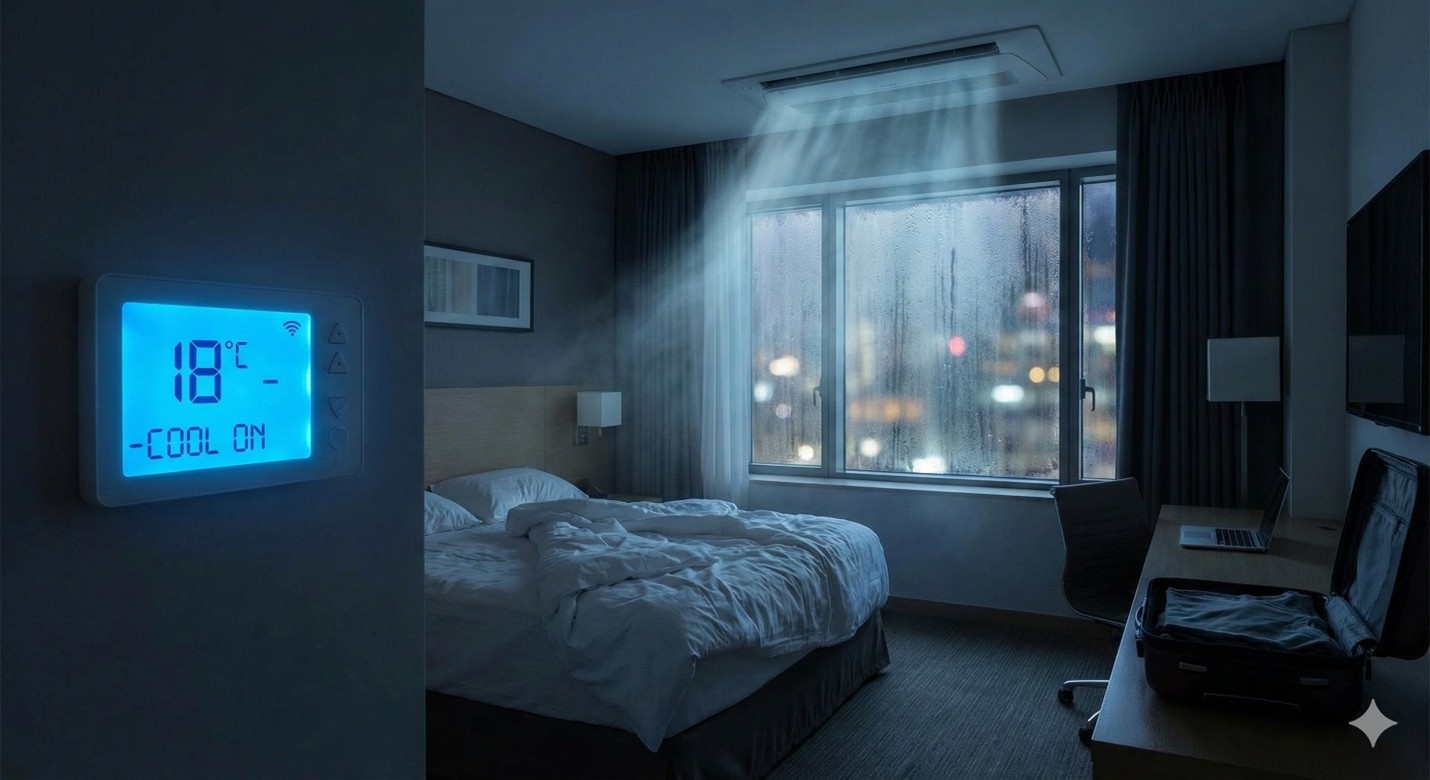
On paper, the HVAC setup in the hotel room looks simple and robust: a fan coil unit (FCU) set to a comfortable 22°C, ready to cool the space whenever a guest walks in. In reality, the system operates 24/7 at the same setpoint, regardless of whether anyone is actually in the room. There is no connection between the FCU and the room door or a key-card system, so from the unit’s perspective, the room is “occupied” all the time.
This means the FCU keeps running even when guests are out for hours at meetings, sightseeing, or dining. It does not adapt to real occupancy, to guest comfort preferences (for example, preferring a slightly higher temperature at night), or to actual indoor air quality (IAQ) needs. The system simply maintains 22°C continuously as long as it is switched on.
Ventilation is another part of the challenge. The FCU itself does not provide fresh air; it only cools and recirculates the air already inside the room. In practice, most of the ventilation happens only when the balcony door is opened, which exposes guests to outdoor noise and street-level pollution. There is no way for the HVAC system to distinguish between moments when fresh air is truly needed and moments when the room could remain closed and quieter, while still maintaining healthy IAQ.
From a business and ESG perspective, this combination creates a significant blind spot. The hotel bears high and largely unmanaged energy costs per room, but lacks reliable data on:
-
- How often and when rooms are actually occupied.
- How IAQ behaves over time (CO₂, particulates, comfort conditions).
- What share of HVAC consumption is genuinely needed versus wasted.
Without this data, it is difficult to quantify savings, to build a credible improvement plan, or to demonstrate compliance with expectations from ESG investors, green building certifications and corporate sustainability teams. The room may appear to run “as usual,” but operationally and financially, it is very far from optimized.
Solution Overview: Sol-In ECO-IN AI Strategy
To address the gap between how rooms behave and how HVAC systems operate, the hotel deployed the Sol-In ECO-IN AI strategy in a single standard guest room. The setup was intentionally minimal: each room requires just one Sol-In IAQ sensor and one Sol-In controller connected directly to the existing fan coil unit (FCU). There was no need to replace the FCU or install complex new infrastructure – Sol-In is designed to leverage the hotel’s current mechanical systems and make them smarter.
Sol-In deployment in a typical 20 m² hotel room – one IAQ sensor and one controller connected to the existing FCU.
Once installed, Sol-In begins continuous monitoring of the room environment and usage patterns. The IAQ sensor collects real-time data on CO₂, PM2.5/PM10, TVOC, relative humidity (RH), temperature and occupancy indicators. This turns every room into a measurable, data-rich space rather than a “black box” with a simple on/off thermostat.
On top of this data, Sol-In AI provides intelligent, demand-based control. Instead of running the FCU 24/7 at a fixed 22°C, the system applies Demand-Controlled Ventilation (DCV) principles:
-
- It adjusts runtime based on whether the room is actually occupied.
- It fine-tunes setpoints and operating intensity during the day and at night, keeping CO₂ and comfort within target ranges while cutting unnecessary cooling.
All data and control logic are managed through a cloud or on-premise server, which supports:
-
- Dashboards, heat-maps and analytics for engineering and management teams.
- Alerts and risk management (e.g., IAQ issues or system malfunctions).
- Automated reporting to support ESG, certification and internal performance tracking.
- The same architecture can later be extended from room FCUs to AHUs in public areas, enabling a unified, building-wide strategy.
At the heart of the project is a strategy shift:
-
- From traditional CAV (constant air volume / constant operation) – the FCU runs regardless of occupancy or IAQ.
- To DCV – an adaptive Sol-In AI mode that responds to real-time occupancy and air quality data.
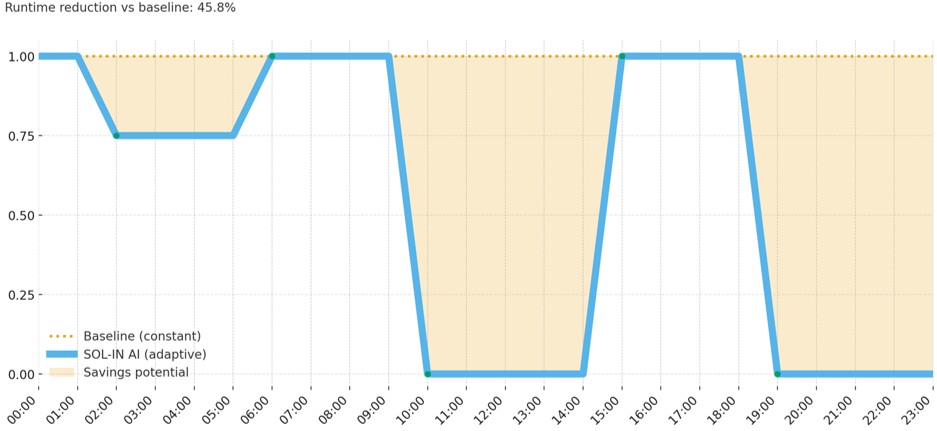
Figure 2: Operating strategy shift from constant 24/7 CAV to AI-driven DCV – Sol-In adjusts airflow and setpoints based on real-time occupancy and IAQ.
Pilot Design & Methodology
The pilot focused on a 20 m² double room designed for two guests, with a balcony door facing the street. This configuration is typical for many city hotels: compact but comfortable, with an FCU providing cooling and heating and the balcony acting as the main source of natural ventilation when opened.
The monitoring period covered 72 continuous hours, from 17 to 19 September, capturing a full guest stay cycle: the check-in day, a complete day and night in the room, and the check-out morning. This window provided a realistic picture of how guests actually use the room over a standard three-day visit.
Under the baseline CAV conditions, the FCU was set to operate 24/7 at 22°C, with no modulation based on occupancy or time of day. There was no automatic shutdown when guests left the room, and no link to the door or a key-card system. As long as the unit was switched on, it maintained 22°C continuously, regardless of whether the room was occupied, partially occupied or empty.
During the pilot, Sol-In captured a rich dataset that included:
-
- IAQ parameters: CO₂, PM2.5, PM10, TVOC and relative humidity (RH).
- Thermal conditions: temperature trends and overall comfort profile.
- Occupancy patterns: inferred from CO₂ dynamics, motion/activity and event timing.
- System behavior: FCU runtime and operating patterns over the full 72 hours.
It is important to note that AHUs in public areas of the hotel were not yet monitored at this stage. The pilot was intentionally focused on a single representative guest room, as a first step toward a broader, building-wide strategy.

Findings – Occupancy & Usage Patterns
The 72-hour monitoring period revealed a clear and repeatable occupancy profile for the room. Guests typically checked in around 15:00 on the first day and checked out around 12:00 on the final day. Within that window, their daily behavior followed a consistent pattern:
-
- Afternoon stay: roughly 13:00–16:00.
- Evening and night: from around 21:00 until about 10:00 the next morning.
Outside these periods, the room was effectively empty – yet the HVAC system continued to operate as if it were fully occupied. When this behavior is aggregated over the full 72 hours, the room was actually occupied only about 44–56% of the time.
By contrast, the FCU operated at full capacity 100% of the time, locked on 22°C. This means that for approximately 40 out of 72 hours, the room was being cooled with no guests present. Those hours represent pure energy waste: the system consumed electricity, added wear to equipment, and maintained comfort conditions for an unoccupied space.
Sol-In’s analytics engine interprets these patterns using a combination of CO₂ dynamics, motion/activity indicators and event timing. Spikes and drops in CO₂ help distinguish between:
-
- Guest presence in the room.
- Housekeeping and cleaning periods.
- Guest changeover windows between check-out and check-in.
This allows the system to identify not only when the room is occupied, but also who is likely present (guests vs staff) and when the room is truly empty, creating a precise basis for demand-controlled operation instead of blind 24/7 cooling.
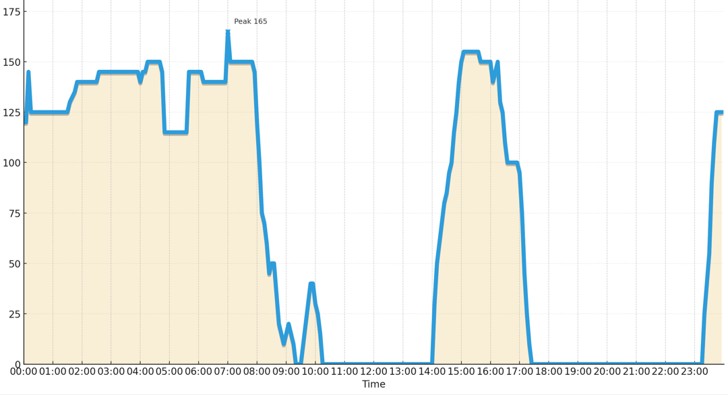
Figure 3: Measured occupancy profile over 72 hours – the room is occupied only about half the time, while the FCU operates continuously at full capacity.
Findings – Indoor Air Quality: CO₂ and Particulate Matter
CO₂ and Ventilation
The pilot confirmed a critical limitation of the current HVAC configuration: the FCU provides no fresh air. It is designed only to cool and recirculate the air already inside the room. As a result, meaningful ventilation occurs almost exclusively when the balcony door is opened by guests or staff. There is no mechanical introduction of outdoor air into the space as part of normal FCU operation.
When the room is empty or only lightly used, CO₂ levels remain low, at around 440 ppm, close to typical outdoor conditions. However, during periods of full occupancy with two guests in a 20 m² room, CO₂ rises to approximately 900–920 ppm. The system recorded a rapid increase and decrease within about 10 minutes of guests entering or leaving, showing how closely CO₂ tracks real-time occupancy.
Overall, the IAQ in terms of CO₂ remains within an acceptable mid-range, but it is entirely dependent on guest behavior: whether they open the balcony door, how long they stay in the room, and how often they come and go. There is no systemic control over fresh-air delivery built into the HVAC strategy. The building, as currently operated, cannot guarantee consistent ventilation performance – it simply reacts passively to door-opening events.
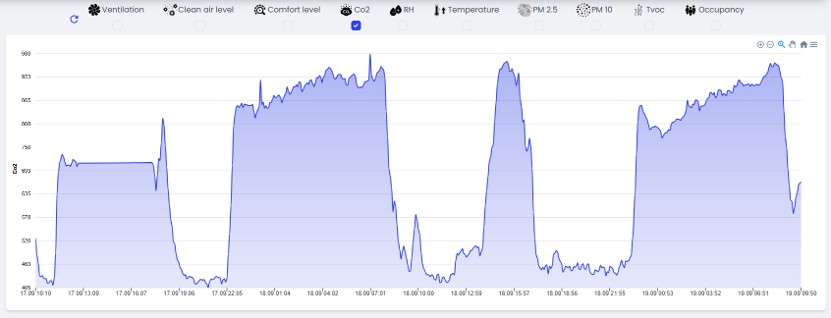
Figure 4: CO₂ trends over a three-day stay – levels remain low when the room is empty and rise to ~900–920 ppm under full occupancy, with sharp changes following guest entry and exit. Ventilation is driven almost entirely by balcony door openings.
PM2.5 and Outdoor Pollution
Particulate matter (PM2.5) told a complementary story. The data showed clear spikes in PM2.5 every time the balcony door facing the street was opened. These peaks coincided with periods of guest presence, cleaning activity and other in-room movement, indicating that external air (and with it, street-level pollution) was being pulled directly into the space.
Each door-opening event effectively trades cooler, filtered indoor air for outdoor air that may contain fine particles from traffic, dust and urban pollution. While some degree of natural ventilation is necessary, this pattern means that guests are periodically exposed to higher particulate concentrations precisely when they are in the room.
By combining DCV-based control with behavioral guidance (for example, encouraging doors and windows to remain closed during occupancy while relying on controlled ventilation during unoccupied periods), hotels can reduce unnecessary exposure to outdoor pollution. Ventilation can be scheduled or triggered when the room is empty, using the mechanical system and real-time IAQ data to refresh the air without compromising guest comfort or bringing in particulates at the worst possible times.

Findings – Thermal Comfort & FCU Runtime
From a temperature perspective, the room initially appears to be well controlled: the FCU maintained a constant 22°C throughout the entire 72-hour monitoring period. However, when this data is viewed alongside actual guest behavior and occupancy patterns, a different picture emerges.
During active hours – afternoons and evenings when guests were moving around the room – 22°C often meant mild over-cooling, especially for a compact 20 m² space. Guests typically need a comfortable, stable environment rather than a permanently “cold” one. At night, the data and observed patterns suggest that a more natural comfort preference would be no cooler than approximately 24–25°C, which is common in hotel sleeping conditions where guests prefer a slightly warmer, less drying environment.
In terms of runtime, the numbers are unambiguous. The FCU operated 24/7, fully on for the entire 72-hour span, with no scheduling or modulation based on occupancy. Over the same timeframe, the room itself was occupied for only about 32 hours. This means that approximately 40 hours of cooling were delivered to an empty room, with no benefit to guests – only additional energy consumption, equipment wear and operational cost.
These findings highlight a major optimization opportunity:
-
- Reducing runtime when the room is empty, by linking operation to real occupancy rather than assuming 24/7 presence.
- Allowing slightly higher temperatures during sleep, aligning setpoints with typical guest comfort preferences instead of rigidly holding 22°C.
Maintaining or even improving perceived comfort, because guests experience conditions that better match their natural expectations, while the hotel avoids wasting energy on unoccupied hours.
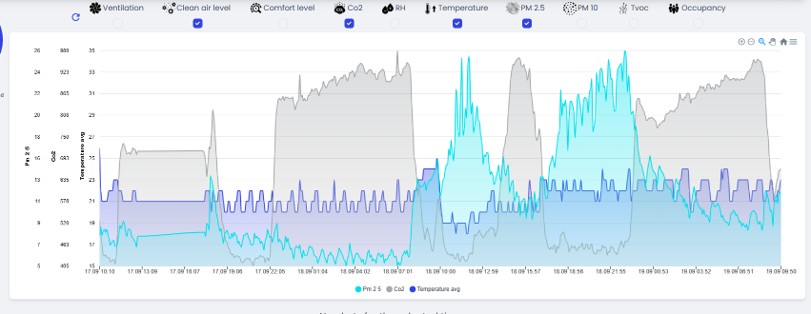
Figure 5: Thermal comfort and FCU runtime over 72 hours – the unit maintains a constant 22°C and runs continuously, even though the room is occupied for only about 32 of those hours.
Mode Comparison: CAV vs Sol-In AI (DCV)
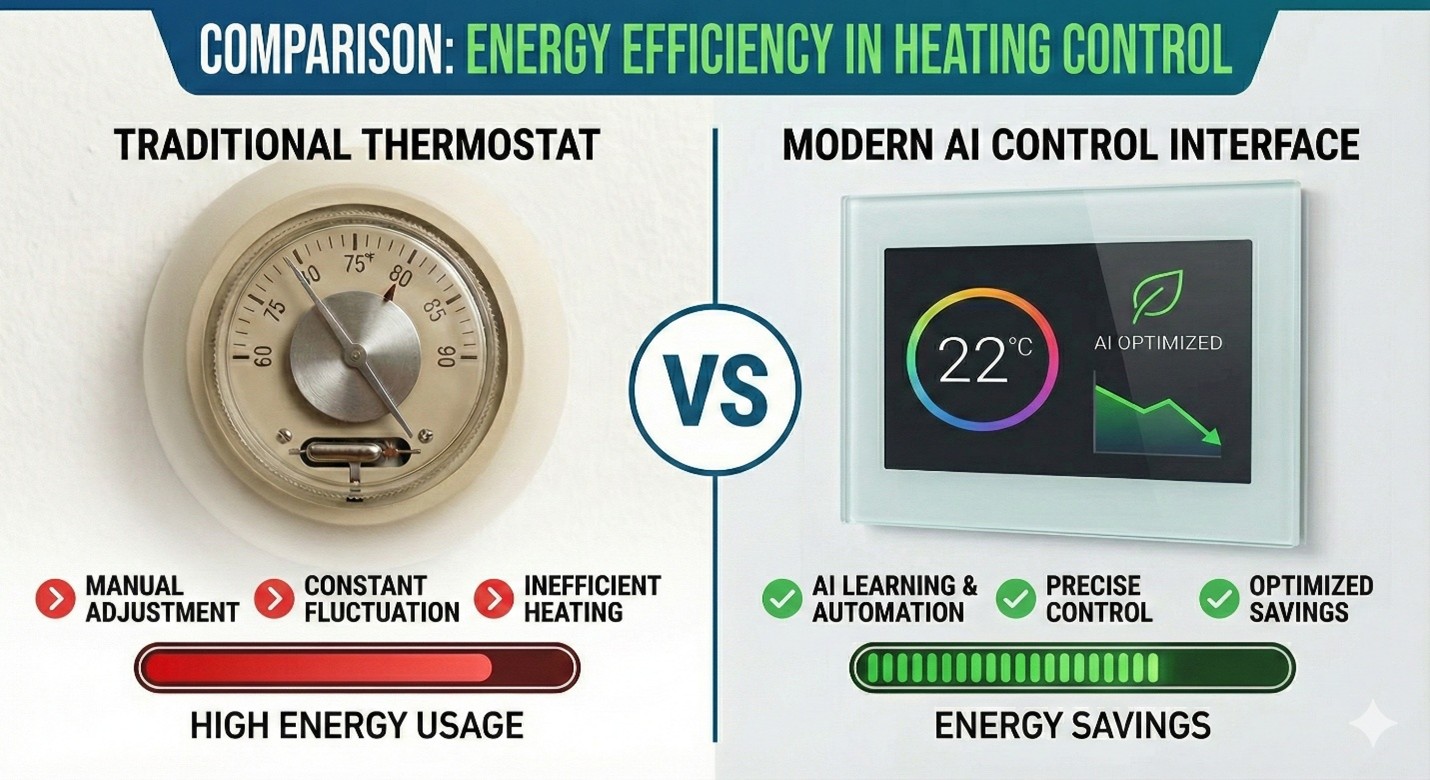
In the baseline scenario, the room operates under a CAV (Constant Air Volume) approach. Practically, this means the FCU runs in constant operation at a fixed setpoint of 22°C, with no awareness of who is in the room, when they are there, or what the indoor air quality looks like. This is still a typical practice in many hotels: simple to configure, but blind to real usage and IAQ conditions.
Under the Sol-In AI (DCV) strategy, the same FCU is controlled in a fundamentally different way. Runtime becomes adaptive, responding to:
-
- Occupancy – the FCU runs when guests are actually present and can be reduced or turned off during unoccupied periods.
- IAQ signals – CO₂, PM2.5 and other IAQ indicators guide when and how strongly the system needs to operate to maintain healthy air.
- Time of day – comfort setpoints can be slightly different for day and night, reflecting realistic guest preferences (e.g., slightly warmer temperatures during sleep).
In the pilot modeling, a typical day profile under Sol-In AI showed the FCU either off or at minimum output during large empty blocks of time (such as late morning and early afternoon), and more active only in well-defined windows:
-
- Morning preparation hours.
- Afternoon rest period.
- Evening and early night, when guests spend the most time in the room.
This shift from “always on” to “only when needed” leads to a runtime reduction of approximately 45.8–56% compared with the CAV baseline, while still meeting IAQ and comfort targets. In other words, the room spends roughly half as many hours actively cooling without any loss in perceived comfort – and often with an improvement, because operation is aligned with real guest presence.
Energy & Cost Savings – Per Room
Translating runtime reduction into financial impact shows just how significant AI-based control can be at the single-room level. Based on the measured behavior and Sol-In’s DCV modeling, the annual HVAC energy cost per room changes as follows:
-
- Baseline CAV (constant 24/7 operation): approximately $980 per room per year.
- DCV with Sol-In AI: approximately $270 per room per year.
- Estimated ECO-IN saving per room: around $710 per year.
In energy terms, this reflects a substantial reduction in the kWh consumed by the FCU over the year, in line with the ~45–56% runtime reduction demonstrated in the pilot. Technical readers can see the exact kWh figures and breakdown in the original analysis chart, which details daily, monthly and annual consumption under both operating modes.
These calculations are based on clear and conservative assumptions:
-
- An average daily occupancy of 44%, consistent with the measured 72-hour profile.
- Reduced nighttime cooling intensity, allowing temperatures to be slightly higher during sleep while remaining within comfort targets.
- No adjustments yet made for seasonal effects or lower-occupancy periods, meaning that real-world savings are likely to be equal or higher once shoulder seasons and low-demand days are factored in.
For hotel operators, this means that every standard room equipped with Sol-In AI can become a predictable, measurable source of annual savings, without sacrificing comfort or IAQ, and without replacing existing FCUs.
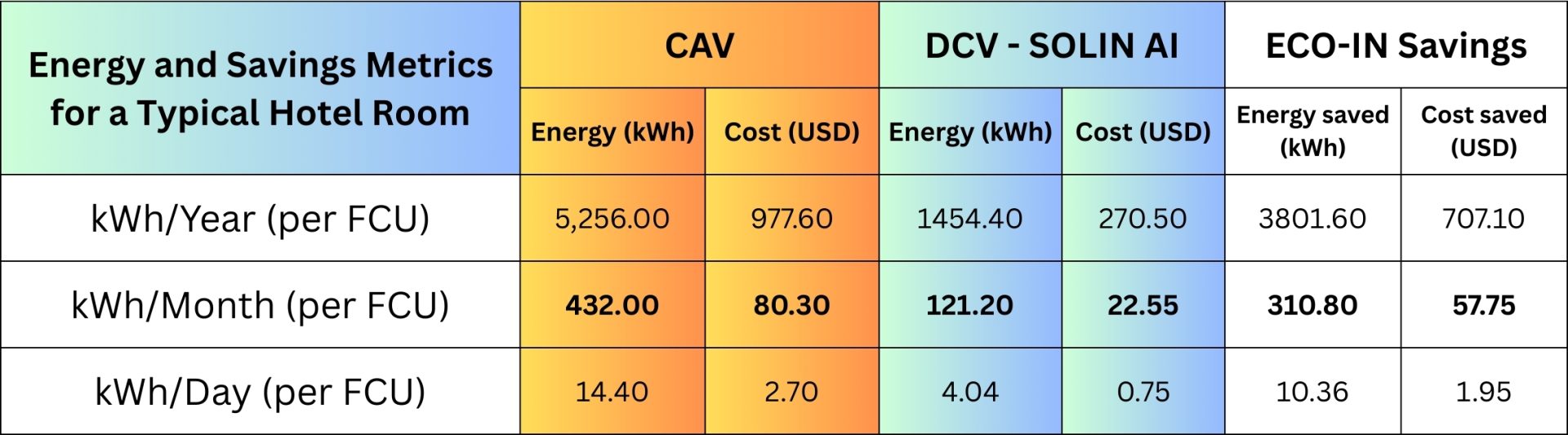
Figure 6: Estimated HVAC energy cost for a single hotel room – comparison of daily, monthly and annual values under constant CAV operation versus Sol-In AI DCV, showing an annual saving of approximately $707 per room.
Energy & Cost Savings – Scaling to the Whole Hotel
When the per-room numbers are scaled to an entire property, the impact becomes highly material at the hotel level. For a 100-room hotel operating under similar conditions, the annual HVAC energy costs for guest rooms change as follows:
-
- CAV – constant 24/7 operation: approximately $97,760 per year.
- DCV – Sol-In AI adaptive control: approximately $27,050 per year.
- Estimated ECO-IN saving for 100 rooms: around $70,710 per year.
These figures are based on the same assumptions used in the per-room analysis: measured occupancy patterns (around 44% average daily occupancy), reduced nighttime cooling intensity, and no adjustment yet for seasonal variation or low-demand days. In practice, this means that room HVAC alone can become a five-figure annual saving line, while also supporting IAQ, comfort and ESG objectives.
Once hardware, installation and integration costs are known for a specific project, it becomes straightforward to calculate a simple payback period. In many cases, the combination of substantial annual savings, reduced equipment wear (thanks to fewer operating hours) and ESG/compliance benefits positions Sol-In AI as a high-ROI investment, with payback often measured in a relatively short number of years.
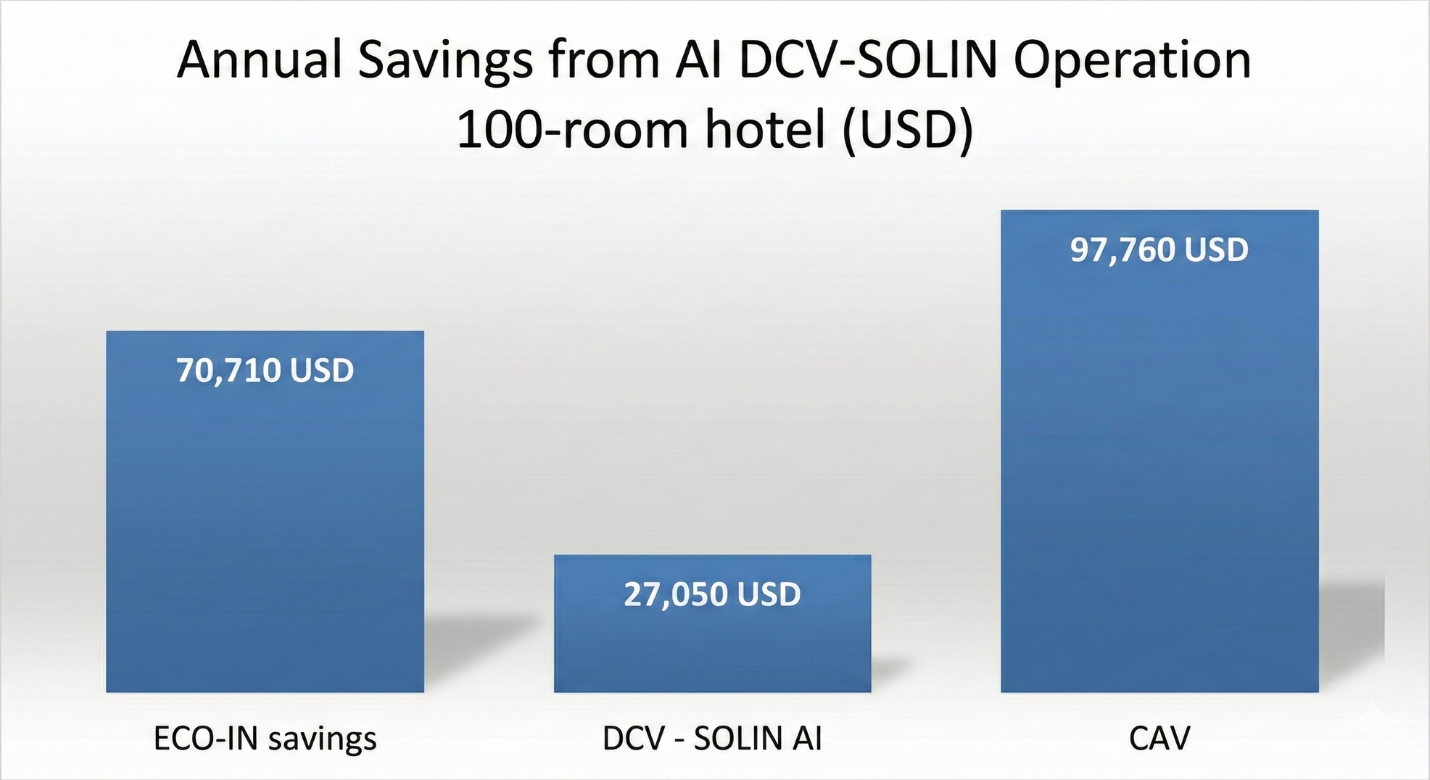
Figure 7: Annual HVAC energy cost for a 100-room hotel – baseline CAV operation versus Sol-In AI DCV, showing an estimated yearly saving of approximately $70,710.
Compliance, MRV & ESG Impact
Beyond energy and comfort, one of the strongest advantages of Sol-In is its ability to provide continuous, high-quality data that supports MRV – Measurement, Reporting & Verification. Because every monitored room becomes a real-time data source, hotel engineers and management teams can:
-
- Prove energy savings over time by comparing pre- and post-implementation performance.
- Run trend analysis across days, seasons and occupancy levels.
- Identify anomalies early (for example, rooms or systems that behave differently from the norm).
This level of transparency is increasingly critical for hotels that are working towards or maintaining green building standards. Sol-In’s monitoring and control approach is designed to align with and support requirements from frameworks such as LEED, WELL, ASHRAE 62.1, RESET and Israeli Standard 528, among others. The same data that drives AI-based control can be used to document compliance with ventilation rates, IAQ targets and energy efficiency benchmarks.
For hotel owners and operators, this translates into practical ESG benefits:
-
- Easier certification and recertification processes, because the required evidence is already being collected automatically.
- Stronger ESG reporting to investors, boards and brand owners, with hard data instead of high-level estimates.
- Tangible proof that reductions in HVAC runtime and energy use do not come at the expense of guest health or comfort – on the contrary, IAQ and thermal conditions are monitored and optimized continuously.
In other words, Sol-In turns HVAC and IAQ from a cost center and regulatory headache into a measurable, reportable asset that supports both operational excellence and long-term sustainability goals.

Recommendations & Next Steps
The results of this pilot point to a clear and actionable path forward for the hotel. The first step is to extend the Sol-In deployment beyond the single test room and into the full guest room inventory. Equipping all guest rooms with one Sol-In IAQ sensor and one controller per FCU would allow the property to replicate the measured savings and comfort improvements at scale, turning room HVAC into a controlled, optimized system rather than a fixed, always-on expense.
In parallel, the hotel can extend monitoring and control to the AHUs in public areas (lobbies, corridors, meeting rooms and other shared spaces) using the same DCV logic tested in the guest room. This would enable a unified ventilation and comfort strategy across the entire building, ensuring that both private and public areas meet IAQ and comfort targets while avoiding over-ventilation and unnecessary energy use.
A further recommendation is to replace the rigid 22°C setpoint with a guest-friendly temperature envelope, for example 22–25°C, controlled by Sol-In AI. Within this range, guests retain the feeling of control and comfort, while the system optimizes operation based on occupancy, IAQ and time of day. This small change can significantly reduce runtime and energy use, without any negative impact on guest satisfaction.
For the wider hotel industry, this case study underlines the importance of treating IAQ and energy as a single, integrated optimization problem, rather than as two competing goals. With the right data and AI-based control, hotels do not have to choose between comfort, health and efficiency – they can achieve all three at once. A practical way to begin is to start with a focused pilot – one room type, one floor or one wing – then scale quickly once the patterns and savings are validated, as demonstrated here.
About Sol-In & ECO-IN
Sol-In is a smart indoor air and energy management company specializing in commercial and hospitality buildings. The company’s solutions are designed to help hotels, offices, healthcare facilities and other large properties improve indoor air quality (IAQ), enhance occupant comfort and significantly reduce HVAC energy consumption – all using the systems they already have in place.
At the core of Sol-In’s offering is the ECO-IN platform: an AI-driven control layer that combines IoT sensors, demand-controlled ventilation (DCV) and advanced analytics. ECO-IN continuously monitors key IAQ and comfort parameters (such as CO₂, PM2.5, temperature and humidity), correlates them with real occupancy, and dynamically adjusts ventilation and HVAC operation in real time.
Sol-In’s technology is designed to integrate flexibly with existing FCUs, AHUs and Building Management Systems (BMS) or to operate as a standalone solution where no BMS is available. This allows building owners and operators to unlock energy savings, improve IAQ and support ESG and certification goals without major mechanical retrofits, using a scalable, data-driven approach.

Subscribe
Popular posts
